


SOC Service Provider for India: Essential Protection for Healthcare
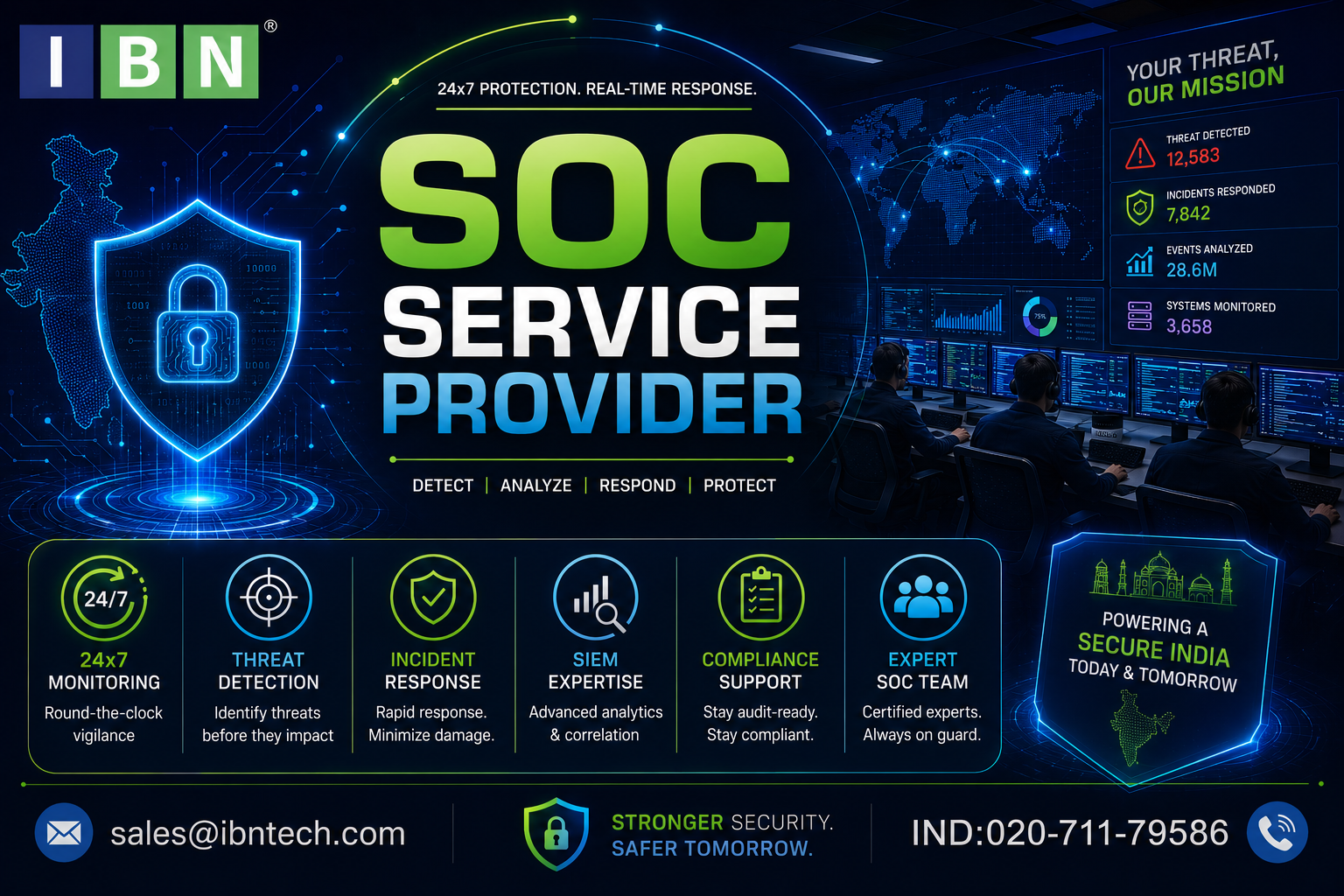
How Healthcare Teams Can Use a SOC Service Provider More Effectively
Healthcare organisations increasingly depend on connected technology to support everyday operations. Digital applications, network infrastructure, endpoints, cloud environments, administrative systems, and other technology platforms all contribute to a modern healthcare environment.
That connectivity also creates more security activity to monitor.
A soc service provider can help healthcare organisations establish a structured approach to security monitoring, threat detection, investigation, and incident response. Rather than treating security alerts as isolated technical events, a SOC can provide an operational process for identifying activity that deserves attention and coordinating an appropriate response.
For Indian healthcare organisations, this becomes particularly relevant when technology environments grow faster than internal security operations.
SOC Service Provider Support for India's Changing Healthcare Environment
A Security Operations Center is a security function that monitors technology activity, investigates relevant alerts, and supports incident response.
For healthcare organisations, the monitoring environment can include endpoints, networks, applications, servers, cloud systems, and other connected infrastructure. The exact sources depend on the organisation's technology architecture.
A SOC service provider can bring these security signals into a structured monitoring and response process.
The central idea is straightforward: security monitoring turns technology activity into visibility that security teams can investigate and act upon.
This is different from simply installing security software. Security tools may generate alerts, but an operational SOC process determines how relevant alerts are reviewed, prioritised, investigated, escalated, and documented.
Why SOC Security Services Need a Healthcare-Specific Context
Soc security services can support healthcare organisations by providing security monitoring and operational processes around threat detection and incident response.
Healthcare environments require particular attention to availability and continuity because technology supports a wide range of business and operational activities. A disruption to a technology system can therefore have consequences beyond an ordinary IT inconvenience.
This does not mean every healthcare organisation requires the same monitoring model.
A smaller organisation may have a different technology environment and internal capability from a large healthcare enterprise. The appropriate SOC scope should therefore be based on the systems being monitored, security objectives, risk profile, and internal responsibilities.
IBN Technologies describes its managed SOC and SIEM services as supporting continuous monitoring, threat detection, incident response, reporting, and compliance-oriented monitoring. (ibntech.com)
Healthcare Security Has a Visibility Challenge
Healthcare technology environments can contain many different systems that were introduced at different times.
Some applications may be relatively modern, while other systems may support long-established operational processes. Cloud services, endpoints, network devices, applications, and other infrastructure may also produce different types of security information.
This creates a visibility challenge.
If security events remain isolated within individual systems, it can be difficult to understand whether several apparently unrelated events are connected.
A centralised monitoring approach can provide broader context.
For example, an unusual authentication event may not automatically indicate a security incident. However, if related activity appears across another system at approximately the same time, the combined information may justify further investigation.
This is where event correlation becomes valuable.
How SIEM and SOC Operations Work Together
A SIEM platform can collect and analyse security information from multiple technology sources. A SOC provides the operational process around that information.
The relationship can be understood simply:
SIEM helps organise and correlate security events; SOC operations help people analyse relevant findings and respond appropriately.
For healthcare organisations, this combination can reduce the dependence on manually checking separate security systems.
IBN Technologies describes its managed SIEM capability as supporting centralised log collection and analysis across on-premises, cloud, and hybrid environments. Its SOC offering adds continuous monitoring, threat detection, investigation, and incident response capabilities. (ibntech.com)
The practical benefit is greater security visibility across the technology environment.
What Healthcare Organisations Should Expect From a SOC Provider
Healthcare organisations should define what they actually need monitored before assessing providers.
The first consideration is coverage.
Which systems should send security information to the monitoring environment? The answer should be based on the organisation's architecture and security priorities.
The second is analysis.
A SOC should have a defined process for reviewing suspicious activity rather than simply forwarding every alert to an internal team.
The third is escalation.
Healthcare organisations need clarity about when an event becomes an incident requiring action and who is contacted when escalation occurs.
The fourth is reporting.
Reports should provide information that security and technology stakeholders can use to understand incidents, investigations, and security activity.
The fifth is responsibility.
An external provider and healthcare organisation should clearly define which activities are performed by the SOC and which remain with internal teams.
Without this clarity, an organisation may have monitoring but still experience delays when action is required.
Why Continuous Monitoring Matters
Security incidents can occur outside normal office hours.
An internal team that relies primarily on daytime monitoring may have limited visibility during other periods unless additional coverage is established.
Continuous monitoring helps address this operational gap.
It allows security activity to be reviewed according to the agreed monitoring model rather than depending entirely on whether a particular employee happens to be available.
For healthcare organisations, the value is not simply having someone watching a dashboard. The monitoring function should have defined processes for identifying significant events, investigating them, escalating incidents, and documenting relevant activity.
That creates a more repeatable security operation.
Avoiding the Trap of Too Many Alerts
More monitoring does not automatically mean better monitoring.
If every event is treated with the same urgency, security teams can quickly become overloaded.
An effective SOC process therefore needs a method for prioritising security events.
Low-value or routine activity should not consume the same investigative effort as an event that potentially indicates a serious security issue.
This is where security analysis becomes important.
Instead of asking only, "Did an alert occur?" teams should also ask what the alert means, what other activity is associated with it, which systems may be affected, and whether further investigation is warranted.
That context allows security teams to focus their attention more effectively.
A Practical Healthcare SOC Evaluation Checklist
Before selecting a provider, healthcare security and IT teams can assess the following areas:
- Systems and environments included in monitoring
- Security event sources supported by the service
- SIEM capabilities for collecting and correlating relevant events
- Continuous monitoring arrangements
- Alert investigation procedures
- Incident escalation criteria
- Communication channels during security incidents
- Incident reporting processes
- Security event and log retention requirements
- Responsibilities of the provider and internal healthcare IT team
- Processes for onboarding new systems
- Reporting for technical and management stakeholders
- Alignment with applicable security and compliance requirements
This checklist helps organisations evaluate the service based on operational requirements instead of focusing only on the provider's technology stack.
Incident Response Requires Clear Ownership
A SOC can identify suspicious activity, but detection is only one part of incident management.
Healthcare organisations should establish what happens after an alert is confirmed.
Depending on the service arrangement, the SOC may investigate an event, classify it, notify the appropriate stakeholders, and provide response recommendations or support. Certain technical remediation actions may remain the responsibility of the healthcare organisation.
These boundaries should be agreed before an incident.
Clear ownership also helps avoid delays. If teams have to determine responsibilities during an active security event, valuable time can be lost.
A documented escalation process provides a more predictable way to handle incidents.
Security Monitoring and the Indian Healthcare Context
Healthcare organisations in India need to consider the security and privacy requirements that apply to their specific operations, technology environment, and information handling practices.
There is no universal compliance checklist that applies identically to every healthcare organisation. Requirements can vary based on the organisation's role, data, contracts, technology environment, and applicable laws or standards.
SOC operations can nevertheless support broader security governance by providing monitoring records, incident information, security reports, and operational evidence.
IBN Technologies' published SOC and SIEM materials reference compliance-oriented monitoring and reporting and identify ISO 27001 and India-specific contexts such as CERT-In among the relevant considerations. (ibntech.com)
Organisations should map these capabilities to their own applicable requirements rather than assuming that the presence of a SOC automatically establishes compliance.
Making Security Monitoring Part of Healthcare IT Operations
Security monitoring should not be treated as an isolated project that ends once a monitoring platform is deployed.
The technology environment will continue to change. New applications may be introduced, cloud resources may expand, users may change, and security risks may evolve.
A SOC service therefore needs an operating model that can adapt with the organisation.
Regular reviews can help determine whether monitoring coverage remains appropriate, whether new systems need to be added, whether escalation procedures remain clear, and whether reports provide useful information to stakeholders.
This makes security monitoring an ongoing operational capability rather than a one-time technology implementation.
A More Structured Security Operation for Healthcare
Healthcare organisations cannot eliminate every security risk simply by outsourcing monitoring.
What an external SOC can provide is a structured operational layer for detecting, investigating, documenting, and escalating security events.
A soc service provider can help Indian healthcare organisations connect security monitoring with broader IT operations through continuous visibility, event analysis, threat detection, incident response, and reporting.
The most effective model depends on the organisation's systems, internal security capabilities, risk priorities, and applicable requirements. When responsibilities are clearly defined, SOC operations can complement the healthcare IT team and create a more consistent approach to security monitoring.
For healthcare organisations, the real value lies beyond the dashboard: it is the ability to turn scattered security signals into meaningful visibility and a coordinated process for responding when something requires attention.
Contact Us:
IND- 02067680404
IBN Technologies Ltd.
E-mail: - sales@ibntech.com
 Russian
 English
 Arabic
 French
 Spanish
 Portuguese
 Deutsch
 Turkish
 Dutch
Dutch
 Italiano
 Romaian
 Portuguese (Brazil)
 Greek
Greek